
Abolishing the Metropolitan Police: My blueprint for a civilised London
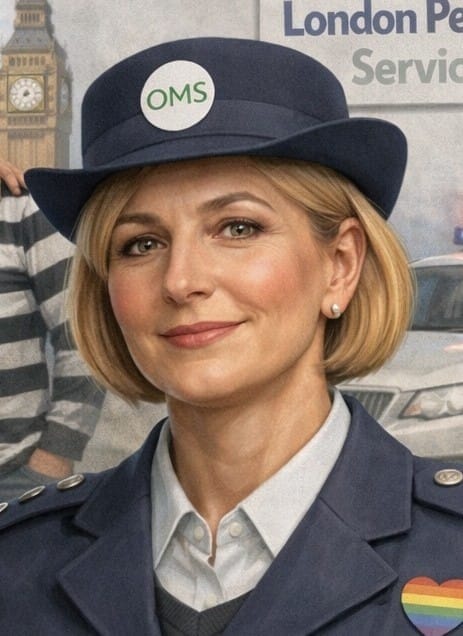
I am proud to be the new Commissioner of the Metropolitan Police. But I am also ashamed of the institution that I lead. For a police officer, I have an unusual background, and this background makes me determines to reform how our city is policed.
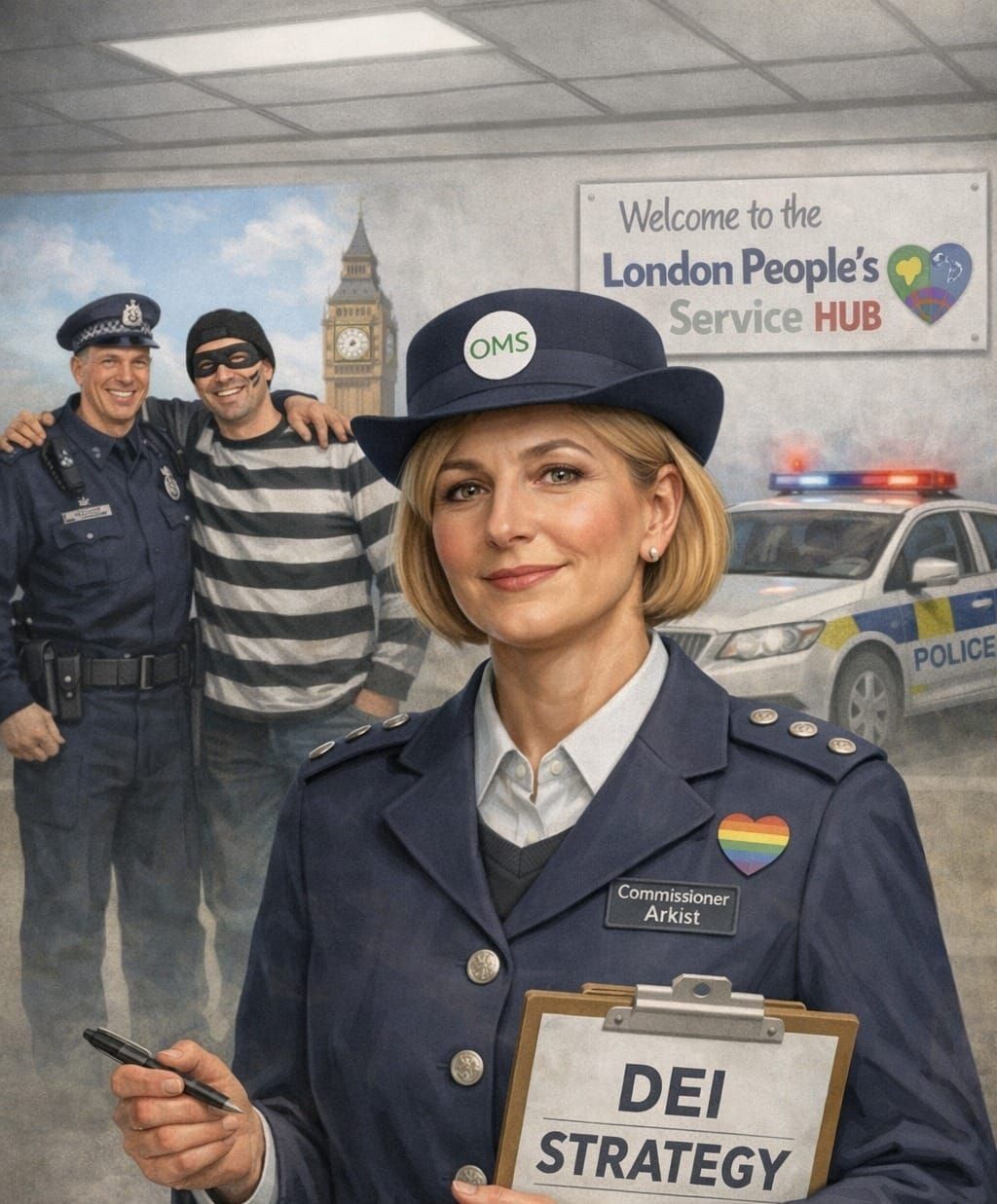
I am proud to be the new Commissioner of the Metropolitan Police.
But I am also ashamed of the institution that I lead.
For a police officer, I have an unusual background, and this background makes me determines to reform how our city is policed.
I decided to enter the police after my PhD in Post-Colonial Restorative Social Work from the Culture War Faculty at the University of Hackney.
During my studies I encountered a revolutionary concept that changed everything I thought I knew about law and order:
Crime is a social construction.
These five words changed my life.
I immediately realised that if crime itself is socially constructed, then the police — whose job is to deal with crime — are also socially constructed.
And if something is socially constructed, the first duty of a modern public servant is to dismantle it.
This simple five-letter phrase, “Crime is a social construct” is so fundamentally powerful that my first act as Commissioner of the Metropolitan Police was to put posters up with this phrase all over London’s police stations.
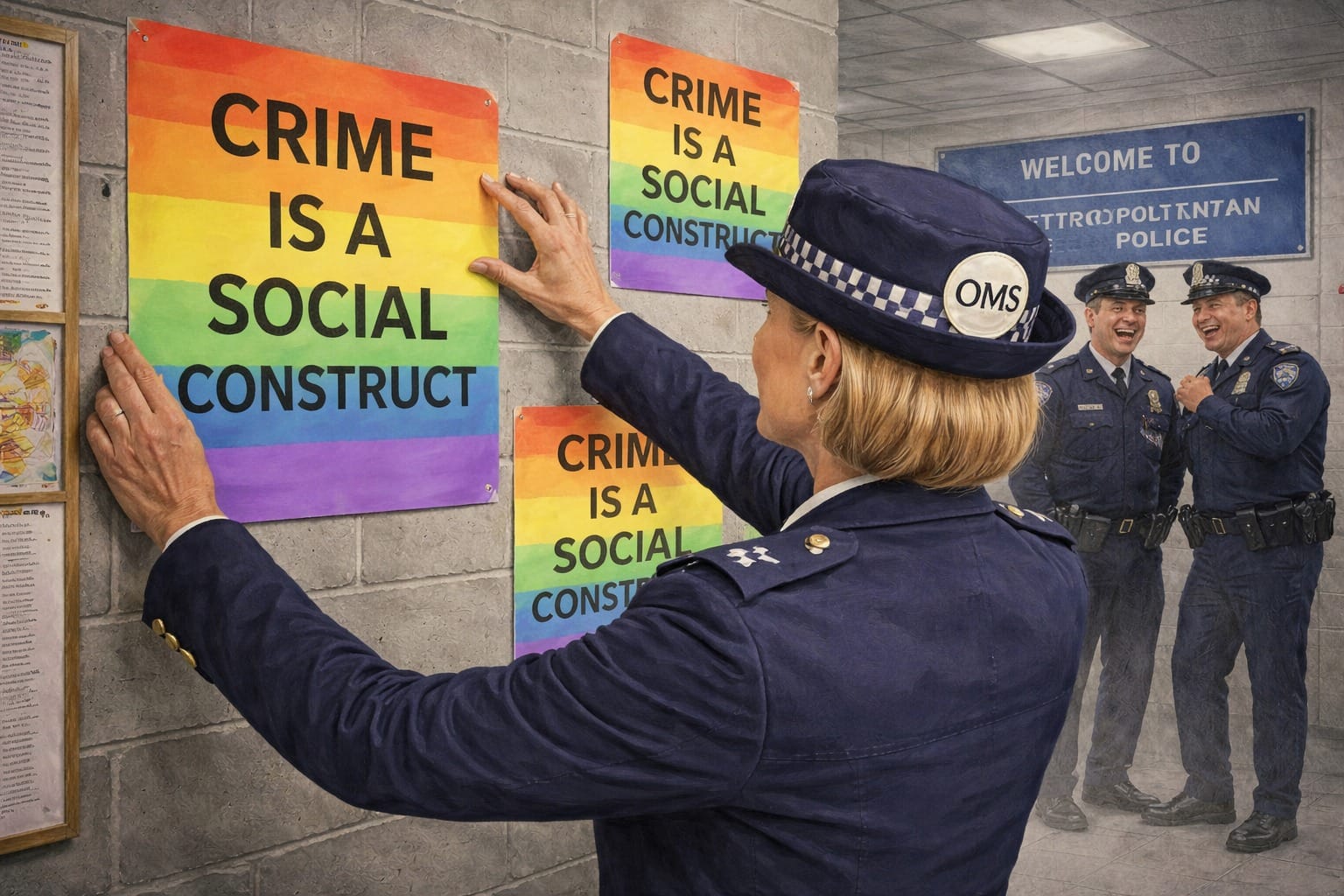
What the phrase means is that the very concept of a what is considered a crime can change over time as societies evolve and laws are updated. For example, some actions that were once illegal may now be legal, and vice versa. This concept of crime is also influenced by social and cultural norms, meaning what is considered a crime can vary between different societies.
For example, many cultures have different views on issues such as marriage ages or domestic discipline. It would therefore be deeply problematic for a culturally insensitive police officer to intervene merely because something appears illegal according to outdated British statutes. We have no greater right to impose colonisation internally than we do externally.
Something else I was taught was that colonisation can just as easily be imposed within Britain by votes in the British parliament as it can be thousands of miles away from Britain by people with guns.
It is our insensitivity to such differences, and our blind faith in absolutes such as right and wrong, or legal and illegal, which I wish to overcome.
For far too long, policing in Britain has been defined by a series of perceived conflicts:
· “police versus public”
· “officer versus suspect”
· “victim versus perpetrator”
· “legal versus illegal”
· “innocent versus guilty”
These divisive categories prevent the kind of collaborative relationship modern policing requires.
That is the old world, and I for one did not join the police to protect the established order, I came to dismantle it.
I for one did not join the police to protect the established order, I came to dismantle it.
The new police should propagate a broader concept of justice not the narrow conception of justice forced on us by established authority.
I have an ambitious agenda, which I will spell out over the coming months, to decolonise the police, but today I want to focus on just one issue: Language.
Language underpins everything.
Recently a middle-aged white male police officer complained in my presence that ‘some thug had stabbed him’.
Of course, I was utterly horrified to hear this.
As I explained to Constable Savage, the word ‘thug’ is a dehumanising term to describe someone and is especially problematic when used against someone of global majority heritage.
The only context where the word “thug” remains acceptable is when describing white English football supporters abroad, whose behaviour places them beyond the protection of civilised norms.
Sadly this distressing example is just one bad apple within a whole rotten orchard.
Our whole system of language around policing is outdated and, from a cultural Marxism perspective, in dire need of modernisation.
The phrase ‘Law and order’ is particularly problematic, implying the supremacy of a particular set of rules and the need for people to behave in accordance with them.
The mixture of words we use for the victims of police actions are also overdue substantial reform. Words such as ‘criminal’, ‘offender’ and ‘perpetrator’ all have connotations of wrongdoing, and many have sinister origins (i.e. “Offender” comes from the Latin offendere, meaning "to hit or strike against”). This language subtly implies wrongdoing, which risks prejudging the situation.
The continued use of these words is indicative of the lack of neutrality shown by Police when faced with interactions between members of the public. However, the most heinous example of inappropriate language is perhaps in the name of our own institution.
The name ‘Metropolitan Police Force’ has colonial overtones and can no longer be justified. Firstly, the word metropolitan implies centralised authority, strongly implying a hierarchical system incompatible with genuine equality.
'Police' has overtones of authority and control, and no matter how many reports are commissioned, reviews undertaken or reforms implemented, the word will likely never be rehabilitated, especially for citizens from ‘global majority’ heritage.
Finally, Force implies a moral right to a monopoly on violence. An easy change would be to use the far gentler and more modern name of ‘service’, to make it clear that the job of the police is to serve the public, regardless of their behaviour.
This is why I propose a renaming to the London People’s Service (LPS), a new institution with new branding and new uniforms. This will eventually integrate with care and social services to form one single social organisation supporting London’s citizens.
In future articles, I will set out how the job of police officer and social worker should obviously be merged into one, why prisons are an outdated institution, and what we should do about the fraught subject of race relations.
Since my appointment was announced, forty-three officers have apparently submitted resignation letters. I view this as evidence that the cultural revolution is already working.
My reforms will face resistance from reactionary elements, both counterrevolutionaries within the police and their allies in the capitalist press.
But nothing will stop the handcuffs of history from being dismantled.
Although this article is free, if you want to continue reading how I plan to decolonise our police, our culture and our country, please subscribe here or buy us a coffee here
Enjoying this post?
If you want to read more of Anne Arkist, please subscribe.
Opinion
Believe all women apart from Mason Greenwood's wife
As a seventh wave post-revolutionary feminist, I live according to one overriding principle, which I will capitalise to leave the reader in no doubt about my sincerity: BELIEVE ALL WOMEN There is just one exception to this rule: Mason Greenwood's wife.
Why Big Ben should be replaced by a Massive Mohammed
As a Christian, I regard it as my duty to support the rights of religious minorities and I’m proud of my patronage of the monthly British Union of Muslim Christian Understanding Meeting's (BUMCUM).

Biden 28-You heard it here first: How Joe Biden can win in 2028
Joe Biden has never lost a Presidential election. He is the only living Democrat eligible to run for office who has never lost a Presidential election he has entered. He is also a proven Trump-slayer, winning a crushing victory against an incumbent President Trump in 2020.

Why I drive on the right as a statement against Brexit
There comes a point in every serious European’s life when symbolic gestures are no longer enough. Posting a Ukrainian flag emoji. Having 'FBPE' in your social media profile. Correcting strangers’ pronunciation of "croissant."